The impact of dyads and extended networks on political talk: A factorial survey experiment in the Netherlands
Abstract
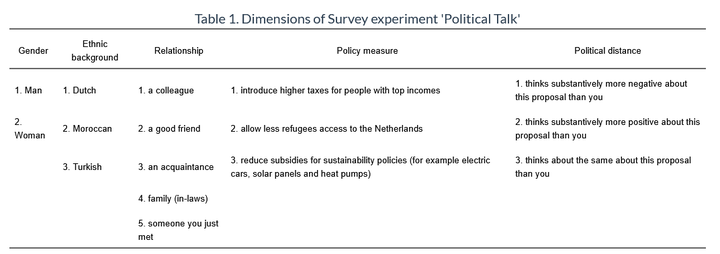
Open political dialogue is regarded as foundational to democratic health and our social fabric. Here, we study political dialogue by examining with whom we prefer to talk about politics and why. In so doing, we develop and test hypotheses about what random encounters (e.g., meeting similar versus dissimilar others, meeting friends or colleagues) foster political dialogue, pose and test conjectures about what features of extended networks facilitate political debate, and present a new unique factorial survey experiment to answer our questions. We incorporated this factorial survey experiment within the NEtherlands Longitudinal Lifecourse Study 2022 (NELLS) and presented to a large sample of Dutch citizens – including Dutch ethnic majority members as well as minoritized Dutch with a Turkish or Moroccan heritage – a choice to engage in political talk or not. Hierarchical linear models reveal that relationship strength, rather than identity similarity (e.g., gender, ethnic), is the primary driver of opting for political dialogue. However, in encounters lacking prior relationship history, gender similarity increases the willingness to engage, and similar political views do relate to engaging in substantive debate modeled dichotomously. Ethnic diversity within extended networks fosters political discussion, while network size has a nonlinear association – medium-sized networks are more conducive to dialogue than very small or very large ones. These findings contribute to debates on political polarization by highlighting the relational conditions that encourage political exchange. Together with the paper we constructed a detailed replication repository/website. Long live Open Science!